

Okay, let’s break down the fascinating world of crystal detectors, stepping back into the early days of electrical engineering and radio. Think of this as a guide to a cool vintage tech piece!
What is a Crystal Detector?
Imagine you’re trying to build a radio receiver way back at the start of the 1900s. You’ve figured out how to catch radio waves, but you need a way to turn those waves into sound you can hear in headphones. That’s where the crystal detector comes in. It was a super important, but now pretty old-school, electronic part used in early radio receivers.
In simple terms, a crystal detector is a piece of special rock (a crystalline mineral) that can do a neat trick: it can rectify an alternating current (AC) radio signal. Why is this important? Radio waves carry information (like sound) by changing their shape (modulation). To hear that sound, you need to separate it from the fast-wiggling radio wave carrier. Rectification is the key step in doing that.
Essentially, it was the very first type of semiconductor diode – a fundamental building block of modern electronics!
Rectification: The process of converting alternating current (AC), which flows back and forth, into direct current (DC), which flows in only one direction.
Semiconductor Diode: An electronic component that allows current to flow significantly in one direction but strongly resists flow in the opposite direction.
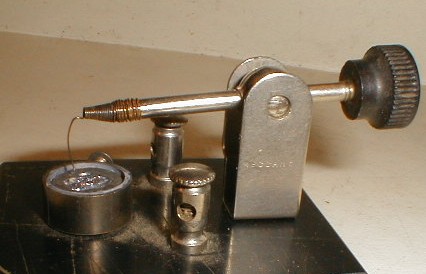
The most famous type was called the cat’s whisker detector. This involved a piece of crystalline mineral, often galena (which is lead sulfide), and a thin, springy wire (the “cat’s whisker”) gently touching its surface.
How Did It Work? (Operation)
Let’s picture the radio signal coming into the detector. It’s an AC signal, meaning the voltage and current are rapidly swinging back and forth, positive and negative. If you just sent this to an earphone, the earphone’s speaker cone would try to move back and forth really fast, but it would average out to no net movement, so you wouldn’t hear anything. The audio information (the sound) is hidden in how the strength of these swings changes over time (this is called Amplitude Modulation or AM).
Here’s the magic: The contact point between the crystal (a semiconductor) and the metal wire forms a simple semiconductor junction. This junction has a special property: it lets current flow easily in one direction but makes it very hard for current to flow in the other direction. It acts like a one-way valve for electricity.
- Incoming Signal: The rapidly wiggling AC radio signal from the antenna and tuning circuit arrives at the crystal detector.
- Rectification: The crystal detector only lets the signal’s current flow through in one direction. It essentially chops off or blocks the part of the signal that would try to flow the other way. This turns the signal from AC (wiggling back and forth around zero) into a pulsing DC signal (wiggling, but only on one side of zero).
- Extracting the Audio: This pulsing DC signal still has the fast radio frequency wiggles, but its average level goes up and down much slower, following the original audio signal (the modulation). This process of getting the audio signal out of the modulated carrier is called demodulation. In this specific case, because the detector works by rectifying the signal’s “envelope” (the outer shape of the AM wave), it’s called an envelope detector.
- Smoothing the Signal: A small component called a bypass capacitor was usually connected across the earphone terminals. This capacitor, along with the resistance of the detector, acts like a filter. It smooths out the fast radio frequency pulses, leaving mainly the slower-changing audio signal.
- Making Sound: This varying audio current then flows through the earphone. The earphone takes this electrical signal and turns it back into sound waves you can hear.
- If it was a piezoelectric earphone, the current made a special crystal inside bend, moving the diaphragm.
- If it was a voice-coil earphone, the current flowed through a coil, creating a changing magnetic field that pushed and pulled a diaphragm.
Important Point: Crystal radios using these detectors had no amplification. The sound you heard in the earphones came only from the electrical energy captured by the antenna from the radio station. This meant you needed sensitive detectors and efficient earphones, and you usually only heard strong, nearby stations well.
Besides radios, these detectors were also used in early scientific setups to detect radio waves or in test gear like wavemeters (instruments used to measure the frequency of radio waves).
Key Historical Steps
The journey to the crystal detector involved several important moments:
- 1874: Asymmetric Conduction Found: Karl Ferdinand Braun, a German physicist, noticed that certain crystalline minerals, like galena and pyrite, didn’t follow the simple rules of electricity (Ohm’s Law). Current flowed more easily in one direction than the other across contacts with these crystals. He didn’t use this for radio yet, as radio waves hadn’t been discovered!
- 1894: First Use for Radio Waves? Jagadish Chandra Bose in India used crystals in his experiments with very short radio waves (microwaves). While he patented a detector in 1901, his early design might have worked by getting slightly warmer when hit by radio waves (like a thermal detector), rather than rectifying like later crystal detectors.
- 1902: The Rectification Discovery: Greenleaf Whittier Pickard in the US made the crucial discovery that the crystal contact itself could rectify radio waves and produce an audio signal without needing an external battery. This happened almost by accident while he was listening to a radio signal and fiddling with his equipment. This realization sparked his massive search for the best rectifying materials.
- Post-1906: Crystals Take Over: Radio researchers realized crystal detectors were much better than the older device called a coherer.
Coherer: An earlier, less reliable type of radio wave detector used before crystal detectors. It typically consisted of metal filings that would “stick together” (cohere) and change resistance when hit by radio waves, requiring a battery and often a mechanical tap to reset. Earphones also became common receiver outputs, which worked well with the crystal detector’s audio output.
Crystal detectors quickly became the main way to receive radio signals until new technology came along in the 1920s.
Different Flavors: Types of Crystal Detectors
Since nobody fully understood why these crystals worked initially (that came much later with quantum physics!), inventors tried lots of different materials and ways of making contact. Finding a sensitive spot was often tricky and varied depending on the crystal.
Cat’s Whisker Detector (Most Common)
- What it is: This was the classic type. It had a piece of crystal and a thin metal wire, often called the “cat’s whisker,” gently touching the crystal’s surface.
- Materials: The most popular crystal was galena (lead sulfide). Other crystals used included iron pyrite (“fool’s gold”), molybdenite, and cerussite. The wire was usually made of phosphor bronze, which had just the right springiness. Sometimes gold or silver needles were used with certain crystals.
- How it worked (modern view): The contact between the fine metal wire point and the galena crystal surface formed a very early type of Schottky barrier diode – a metal-to-semiconductor junction that rectifies.
- The Challenge: Only certain spots on the crystal surface would work well. And the contact was very sensitive to pressure and vibration. Even a small bump could knock it out of adjustment.
- Adjustment: Because of this fussiness, you had to adjust it manually before each use. The wire was usually on a movable arm. You’d slide or drag the wire across the crystal surface while listening in the earphones for a radio station or even static noise. Finding a good spot took patience and skill! An old trick was using a buzzer connected to the radio to create a test signal; when you found a sensitive spot, you’d hear the buzz loudly.
- Construction Details: The crystal piece (often pea-sized) was held in a metal cup. It was important the crystal made good electrical contact with the cup, usually by clamping or embedding it in solder (often a low-melting point alloy like Wood’s metal to protect the crystal). The cat’s whisker wire was on an adjustable arm so you could carefully probe the crystal surface. Professional versions often had a coil in the wire to act like a spring for delicate pressure control.
Carborundum Detector
- What it is: Invented by Henry H. C. Dunwoody. This type used a piece of silicon carbide (known back then as carborundum).
- Materials: Silicon carbide (SiC), usually touching flat metal plates or a hardened steel point pressed firmly against it.
- Key Difference: Unlike the delicate cat’s whisker, this detector needed and could handle heavy pressure on the contact.
- Advantages: This made it much more robust and less sensitive to vibration. It didn’t need constant readjustment like the galena cat’s whisker. Some were even adjusted at the factory and sealed. It could also handle higher electrical currents without getting damaged (“burned out”), useful if lightning static or strong signals hit the antenna.
- Use Cases: Because it was so sturdy, it was often used in places with lots of vibration, like shipboard wireless stations or military setups near artillery fire. It was common in commercial telegraphy stations.
- Special Feature (Bias): Silicon carbide has a wide band gap (a property in semiconductors related to how current flows). To make it more sensitive, engineers often applied a small forward bias voltage (around 1 volt) from a battery and adjusted it with a potentiometer (a variable resistor). This pushed the operating point of the detector onto a steeper part of its electrical characteristic curve, making it more responsive.
Silicon Detector
- What it is: Patented and first sold commercially by Pickard.
- Materials: Used a piece of fused silicon with a metal point (like brass or gold) pressed against it, often with a spring for pressure.
- Pressure: Needed more pressure than galena but less than carborundum.
- Advantages: Like the carborundum detector, its firm contact was much less affected by vibration than the cat’s whisker. It also didn’t typically need a bias battery like the carborundum detector.
- Use Cases: Widely used in commercial and military radio stations due to its reliability compared to galena.
Crystal-to-Crystal Detectors
- What it is: Instead of a metal point on a crystal, this type used two different crystals touching each other.
- The Most Famous: The “Perikon” detector, also invented by Pickard. “Perikon” stood for PERfect pIcKard cONtact.
- Materials: It used a contact between a crystal of zincite (zinc oxide) and a crystal of chalcopyrite (a copper iron sulfide) or sometimes bornite.
- Construction: Pickard’s design often had multiple small zincite crystals set in a cup (they were fragile and could “burn out” from strong signals or static) and a chalcopyrite crystal on an adjustable arm that you’d move to touch a zincite crystal until you found a sensitive spot.
- Bias: Sometimes used a small forward bias (around 0.2V) for extra sensitivity.
- Other Pairs: Scientists experimented with other crystal pairs too, like zincite and carbon, or silicon with arsenic or antimony.
Why They Were Important and Where They Were Used
Crystal detectors were the workhorses of early radio for a significant period.
- Crystal Radios: They were the core component of the first type of radio receiver widely used by the general public. These simple radios were cheap to build and operate (no batteries needed for the detector itself!), making radio accessible to many. They remained popular until the 1920s.
- Commercial and Military Radio: Before vacuum tubes were common, crystal detectors were used in sophisticated receivers at professional wireless telegraphy stations for point-to-point communication (like sending Morse code telegrams across the ocean). Their sensitivity was critical for picking up weak signals from long distances. The robust types like Carborundum and Silicon detectors were preferred in challenging environments.
- Scientific Labs and Test Gear: They were used by scientists studying radio waves and in instruments like wavemeters to calibrate transmitters.
The Science Catches Up: Understanding How They Worked
For years, engineers and scientists knew crystal detectors worked, but they didn’t truly understand why. They suspected it had something to do with “imperfect” electrical contacts.
- Early Theories Wrong: Some thought they worked because of heat effects (thermoelectric effect). But experiments by George Washington Pierce using early oscilloscopes (built with Braun’s cathode ray tubes!) showed this wasn’t the case; the electrical response was instant, not delayed by heating or cooling.
- Quantum Mechanics is Key: The real explanation had to wait for the development of quantum mechanics in the 1920s and the birth of semiconductor physics in the 1930s.
- Understanding Semiconductors: Scientists figured out that the special conductivity properties of materials like silicon and galena fell between conductors and insulators – hence the name semiconductor. Key concepts like band theory (explaining how electrons move in crystals) and the idea of holes (missing electrons that act like positive charge carriers) were developed.
- Impurities are Crucial: A big breakthrough was realizing that the rectifying behavior wasn’t just the crystal itself, but depended on tiny amounts of impurity atoms mixed into the crystal lattice. The variations in detector performance from one piece of crystal to another, or even spot to spot on the same crystal, were due to differences in where and how many impurity atoms were present.
- Doping and Reliability: As scientists learned to make incredibly pure crystals and then add precise, controlled amounts of specific impurities (doping), they could finally create semiconductor junctions with predictable and reliable characteristics. This was essential for manufacturing modern diodes.
- Putting it Together: The theory of how metal-semiconductor junctions (like the cat’s whisker) rectify was developed independently by Walter Schottky and Nevill Mott in 1938. Later, William Shockley’s work in 1949 led to the Shockley diode equation, mathematically describing the non-linear electrical behavior that Braun observed back in 1874 and that makes rectification possible.
Beyond Detection: Early Semiconductor Discoveries
Interestingly, experiments with crystal detectors led to a couple of other amazing discoveries, decades before they were fully understood or used:
- The Crystodyne (Negative Resistance Amplifiers/Oscillators): Some biased crystal junctions, particularly zincite ones studied by Oleg Losev in the 1920s, showed a property called negative resistance. This means that over a certain range, as you increase the voltage, the current actually decreases. Normally, devices have positive resistance (current increases with voltage). Negative resistance is cool because it allows a device to act as an amplifier or even generate oscillations (like a radio transmitter!). Losev built solid-state amplifiers and receivers using this effect, long before the transistor. His work was largely forgotten outside Russia, and the concept of negative resistance in diodes was “rediscovered” with the invention of the Tunnel diode in 1957. Today, negative resistance diodes like Gunn diodes are used in microwave circuits.
- The Light Emitting Diode (LED): In 1907, Henry Joseph Round noticed that his carborundum detector gave off a faint light when current flowed through it. He’d built the world’s first LED! Again, Losev in the 1920s did detailed studies of this light emission from carborundum and zincite, figuring out it was a “cold” light not caused by heat. He even guessed it might be related to the opposite of the photoelectric effect (where light creates electricity). He published his findings and envisioned practical uses, but like his work on negative resistance, it was largely ignored until the modern LED was developed much later.
The End of an Era (Mostly)
By the 1920s, the vacuum tube, especially the triode (invented by Lee De Forest), had arrived. Vacuum tubes could amplify radio signals, something crystal detectors couldn’t do. This meant receivers could pick up weaker stations, drive loudspeakers (no more headphones only!), and were generally easier to use than adjusting a cat’s whisker.
Vacuum tube radios quickly replaced crystal radios for most people and in commercial/military use. The fussy, somewhat unpredictable nature of the crystal detector was a big reason for this rapid change. As one early researcher put it, the variability of crystal detectors seemed almost “mystical” and was viewed with skepticism by later engineers used to the more consistent vacuum tubes.
However, crystal radios didn’t completely disappear:
- They remained a cheap alternative for those who couldn’t afford tube radios.
- Building a crystal radio became a popular educational project (still is today!).
- They were sometimes kept as emergency backup receivers.
- During World War II, simple crystal radios were used as clandestine receivers in occupied territories because they were easy to hide and didn’t need a power source that could be traced.
After WWII, with the rapid growth of semiconductor physics and the invention of the transistor (which grew out of the research into those early point contacts!), reliable, mass-produced modern semiconductor diodes (like germanium diodes and later silicon diodes, such as the famous 1N34) became available. These modern diodes performed the same rectification job as the old crystal detectors but were tiny, consistent, and didn’t need adjustment.
Today, the galena cat’s whisker detector is mainly a historical curiosity, used for building replica crystal radios or in science education kits to demonstrate basic radio principles and the history of electronics. But its place as the very first semiconductor diode is secured, having paved the way for the entire field of solid-state electronics that powers our world today.